to top

Thesis Topic
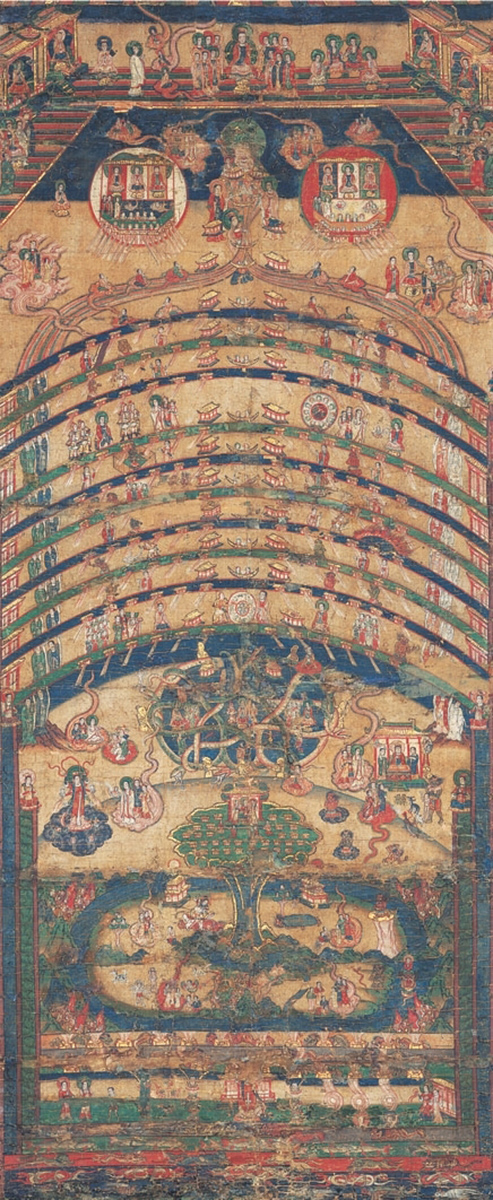
The Manichaean Diagram of the Universe (Japanese: マニ教宇宙図) is currently housed in Japan. The map measures 137.1 cm in length and 56.6 cm in width. It is a colored religious painting created by a Fujian-Zhejiang painting workshop during the Yuan and Ming dynasties. The artwork depicts the Manichaean cosmic landscape of “ten heavens and eight earths”. As the only extant visual representation that fully illustrates the Manichaean cosmogony, it bears witness to the grand scale of the Manichaean world as described in Mani’s own “Book of Pictures” (Ārzhang). Based on the classification by Yoshida Yutaka and Zsuzsanna Gaulácsi, the entire painting can be divided into seven main layers, with numerous further subdivisions of pictorial combinations between scenes. A total of 589 figures are depicted, showcasing highly complex pictorial patterns and an extremely rich interplay of knowledge and iconography.
Previous studies have often relied on extensive textual analysis to interpret the Manichaean cosmological doctrines depicted in the map. However, as acknowledged by scholars from Furukawa Seichi to Kósa Gábor, the overall style of the map is heavily influenced by Buddhist aesthetics, and it contains numerous imagery and pictorial expressions that cannot be fully explained through textual analysis or doctrinal interpretation alone. As the first universal religion to spread across the Eurasian continent, Manichaeism achieved the greatest possible explosion of religious knowledge and cross-cultural practice within the framework of “ancient globalization”. It employed a form akin to “comparative interpretation”, leveraging the doctrines and conceptual imagery of locally thriving religions to transcribe its own teachings. Compared to the complex textual translation, Manichaeism, which used images as an important means of proselytization, also underwent this process at the image level. At the same time, as the producers and recipients of images, how did the Manichaean religious groups and workshop artisans in the Jiangnan Han region understand, accept, utilize, and employ these images? How did they transcribe and even transform the Manichaean cosmological world into Han Chinese expressions based on their familiarity with Buddhist and Daoist knowledge and visual conventions? The author hopes to re-examine this highly complex and diverse work to gain insight into how the Manichaean Diagram of the Universe accommodates various visual elements spanning East and West, as well as religious boundaries, and how it constructed the Manichaean world system in the Jiangnan Han Chinese region, which was markedly different from Persia and the Western Regions. Simultaneously, the study explores the possibility of providing new interpretive pathways for such unique religious art objects through a cross-regional, cross-cultural, and cross-religious art historical research perspective.